Turbo start agent is a starter marketing site. Your developers keep working in git. Your team edits through the agent they already use.
Turbo start agent is a starter marketing site. Your developers keep working in git. Your team edits through the agent they already use.


Powering marketing teams at
What you get
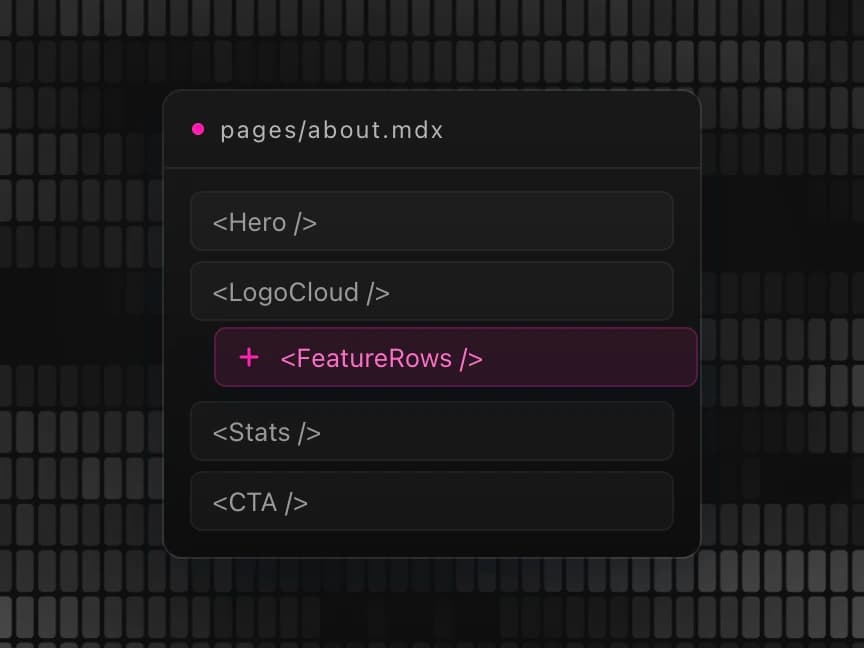
Compose pages from a library of pre-built sections instead of hand-rolling layout for every client.
Browse the blocksIt's plain-text MDX: diffable, reviewable as a pull request, revertible, and directly editable by an AI agent.
See how content worksRebrand a client site by editing a handful of CSS variables, not hunting hex codes through the codebase.
Open the style guideBy the numbers
/ 8 HR DAY
tokens.css
Preview-ready
Preview a block and it already reads like a finished page. Swap the copy when the client's ready, not before.
From the agencies
The block registry is the first thing I show new hires. They're shipping client sections in their first week instead of their first month.
 Casey OkaforFounder, Northbound
There is no CMS to learn. Content is MDX files in content/, validated at build time, and a lockdown on what MDX can contain means an agent can edit those files directly, without a database or an admin panel.
Most agencies using this go from clone to a live client preview in an afternoon: swap the token file, drop in the client's copy and logo, pick block variants per section. The parts that used to take a week (layout, spacing, responsive behavior) are already decided.
Most take an afternoon. A rebrand is a token swap rather than a rebuild: the block tree and the copy stay exactly where they are while the design tokens carry the new palette, type, and spacing across every section at once.
You build it once, following the same props-and-schema pattern as every other block, and it slots into the registry alongside the built-ins. It is an addition to the template rather than a fork of it, so the next client project gets it for free too.
Today it only reads from MDX in git. The registry is a mapping from a type string to a component, but the safety guarantee comes from the lockdown that inspects MDX at build time. Swap the source and you'd rebuild that check, not just add an adapter.
Yes. The site builds to a standard Next.js app, so you can host it on your own infrastructure as long as your servers can run the production build and provide the environment variables your project uses.
Yes. It ships MIT-licensed specifically so agencies can rebrand, resell, and reuse it across client engagements without asking permission or crediting the template anywhere client-facing. That includes the footer: there is no attribution line to keep or link back to, so the only name in a client's footer is the client's own.
MIT-licensed. Clone it, edit the content in git or through any agent, and ship your own site.
 hero
 home.fig
 GitHub